Work Packages & Alignment
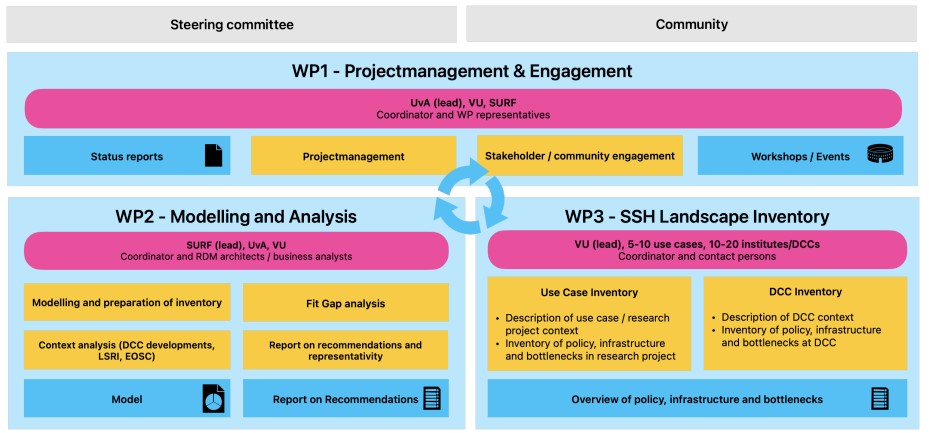
This project is organized into three interconnected Work Packages (WPs), each focused on a specific domain of activity. Together, they form a cohesive structure that ensures effective coordination, strategic development, and practical implementation of solutions that align with ongoing national initiatives in the social sciences and humanities (SSH) domain. Below is an overview of each Work Package, including key activities and their alignment with external efforts.
This project actively seeks alignment with ongoing national efforts in research data management (RDM) and digital infrastructure. By engaging with initiatives that share common goals in the SSH domain, we aim to build on existing strengths, foster collaboration, and ensure that our outcomes are sustainable, interoperable, and beneficial to the broader research community.
Work Package 1 (WP1)
Lead: University of Amsterdam (UvA)
WP1 is responsible for the overall coordination and operational management of the project. It ensures that all activities are executed according to plan, that communication across stakeholders remains active and transparent, and that the project team is supported in achieving their goals. This Work Package plays a central role in aligning the efforts of all partners and maintaining strategic engagement with relevant national organizations and communities in the SSH landscape.
Core Activities:
- Establishing a steering committee/advisory board composed of project applicants and representatives from key national stakeholders.
- Developing and maintaining a comprehensive project and communication plan to guide the work and ensure stakeholder transparency.
- Actively engaging with institutions, organizations, and communities across the SSH domain to maintain ongoing dialogue and collaboration.
- Providing operational and strategic support to all project contributors and coordinating inter-WP collaboration.
- Monitoring the project’s overall progress, drafting status reports, and initiating interventions when needed to keep the project on track.
Work Package 2 (WP2)
Lead: SURF
WP2 focuses on strategic analysis and modelling to inform the design of future-proof RDM infrastructure tailored to the SSH domain. This includes understanding current gaps, mapping policy and infrastructure landscapes, and delivering practical recommendations that support interoperable, scalable, and sustainable solutions. This Work Package provides the analytical and architectural groundwork needed to inform infrastructure design and policy alignment.
Core Activities:
- Modelling the existing landscape of SSH data policies, infrastructures, and workflows to support comprehensive analysis.
- Conducting fit-gap analyses to identify where current RDM infrastructures fall short of the needs of SSH researchers and institutions.
- Developing structured recommendations to support feasible and sustainable enhancements to the RDM ecosystem.
Work Package 3 (WP3)
Lead: Vrije Universiteit (VU)
WP3 focuses on mapping the current research data management (RDM) services and infrastructure available to the SSH domain in the Netherlands. The goal is to create a structured inventory of existing tools, services, and initiatives, and to explore opportunities for alignment, collaboration, and shared development. This work package builds on the models and recommendations from WP2 and engages closely with stakeholders to ensure an accurate and up-to-date overview of the national landscape. To further illustrate shared challenges, needs and opportunities in the SSH-domain, WP3 examines use-cases of the research life cycle (midway to complete research projects) to identity where fragmentation and hurdles exist. In collaboration and conjunction with WP2, these Work Package activities elevate recommendations to become more grounded in practice.
Core Activities:
- Conducting an in-depth inventory of existing RDM tools, services, and workflows used across SSH institutions.
- Selecting a set of representative use cases that illustrate shared challenges, needs, or opportunities within the SSH community.
- Engaging with stakeholders from national projects to explore opportunities for alignment, integration, or reuse.
- Testing insights and recommendations from WP2 against real-world conditions to assess feasibility and impact.
National Alignment
TDCC-SSH
This project has been reviewed by NWO, and is funded as a 2024 TDCC-SSH Challenge Project. It addresses three key challenges outlined in the TDCC-SSH Roadmap by providing recommendations to tackle these in future developments:
- Support: Improving the RDM infrastructure involves creating streamlined, integrated, and largely automated support workflows that improve communication, develop documentation and training, and encourage adoption of RDM products and services.
- Sensitive data: Improving the RDM infrastructure enables researchers and institutes to manage their data effectively, ensuring easy access to relevant sources and supporting the management of sensitive data. It also increases FAIR access through secure data exchange, enforced terms of use, and diverse access policies.
- FAIR data and software: Currently, a significant amount of valuable data is still not being made available. An appropriate RDM infrastructure provides researchers with the support and services needed to archive and publish their (meta)data distinguishing between FAIR for the world (open) and FAIR for the institute (closed).
More information about the TDCC-SSH Roadmap can be found here.
More information about TDCC-SSH projects can be found here.
SLIPPRS
This TDCC-SSH Bottleneck project also focuses on landscaping RDM through analysis of SSH policies and assessing infrastructural components. We’ve established contact between our teams and agreed to share a corpus of SSH policies, as well as exchange deliverables related to mapping SSH infrastructure. Several members of the MICR core team are also actively involved in SLIPPRS (Surveying the Landscape of Infrastructure, Policies, and Practices in Research Data Management in Faculties of Social and Behavioural Sciences).
More information about SLIPPRS can be found here.
SPII / Meta-Project
MICR shares similar objectives with the SPII project (Strategisch Plan Integrale Infrastructuur voor Open Science), particularly in assessing the current state of research data management (RDM). Still, SPII has a more high-level approach and broader scope (all disciplines, all infrastructures, also including scholarly communication and research information), while MICR’s domain-specific focus and extended project timeline allow for more in-depth exploration. Here too, there is team overlap between MICR and SPII.
More information about SPII can be found here.
SSHOC-NL
SSHOC-NL (Social Sciences and Humanities Open Cloud Netherlands) is a large-scale research infrastructure project funded by NWO, bringing together ODISSEI and CLARIAH to develop advanced digital infrastructure for the SSH domain. Given MICR’s focus on modular RDM infrastructure, aligning with SSHOC-NL offers opportunities to ensure compatibility and complementarity between our initiatives.
More information about SSHOC-NL can be found here.
Closed Archive Project
This is a TDCC-SSH Challenge project recently submitted for the 2025 round of financing. It aims to develop solutions for the secure archiving of sensitive research data in collaboration with service providers like DANS and SURF. Closed archiving is a crucial component of comprehensive RDM that both SPII and MICR recognize.
The description of the project (as pitched on Tue 13th of May for community review) can be found here.